Public Company Financial Modeling with Claude or ChatGPT

Public Company Financial Modeling with Claude or ChatGPT adalah training dua hari yang mengubah laporan tahunan perusahaan terbuka menjadi model keuangan yang teruji. Anda mengerjakan sepuluh langkah, dari annual report sampai skenario, dengan bantuan Claude atau ChatGPT. Program ini tersedia sebagai pelatihan publik maupun in-house, dengan jadwal bulanan sepanjang 2027.
Banyak analis menghabiskan berhari-hari hanya untuk menyalin angka dari laporan keuangan ke Excel. Setelah itu, mereka masih harus menyusun proyeksi, memeriksa kesalahan, dan menguji risikonya. Training ini memangkas pekerjaan berulang tersebut. Claude atau ChatGPT mengerjakan bagian yang repetitif, sedangkan Anda tetap memegang kendali atas sumber data, rumus, dan hasil akhir di Excel.
Slogan program ini sederhana: Spread | Analyze | Forecast | Integrate | Assure | Stress Test. Setiap kata mewakili satu fase kerja dalam proses public company financial modeling yang akan Anda praktikkan langsung.
Course Description
A hands-on, two-day workshop using Claude or ChatGPT to build a public company financial model. Participants spread five years of audited statements, build and analyze a linked three-statement model, project five years ahead, run model checks, then apply Tornado and MIDAS scenario analysis.
The same ten-step workflow and 12-sheet architecture apply to either platform. Participants build in stages, validate in Excel, and consolidate their prompts into a master rebuild specification. Sector-specific drivers and human sign-off remain central.
- 2 days: 09:00 to 17:00 each day
- 10 steps: annual report to scenarios
- 12 sheets: workbook with checks
- 1 master prompt: guides a staged rebuild
Who Should Attend
Financial modeling analysts and practitioners with Excel proficiency and knowledge of the three statements. Bring a laptop, desktop Excel and access to either Claude or ChatGPT with file upload and workbook creation enabled.
Course Objectives
By the end of the course, participants will be able to:
- Spread and standardize: Turn audited annual reports into a time series and historical input sheets, in reporting currency.
- Build and analyze: Build a linked historical three-statement model and read it through ROE = ROS × ATO × ALEV.
- Forecast with drivers: Set sector-specific assumptions and supporting schedules with formula-driven calculations.
- Integrate and assure: Join 5 actual and 5 projected years, with 41 error checks and 13 alerts in one master check.
- Stress test: Rank key drivers with a Tornado chart and compare six scenarios on nine drivers with MIDAS.
- Scale with prompts: Use either AI platform to develop a master prompt for a staged rebuild, with human sign-off.
Using Claude or ChatGPT
One workflow and one Excel model, using the participant’s chosen AI platform.
- Access and setup: Before class, test file upload and workbook download on your chosen platform. Bring desktop Excel.
- Shared course materials: Use the same source pack, 12-sheet specification and defined checks. Keep units and sign conventions explicit.
- Prompts with checkpoints: Work one step at a time. Specify inputs, formulas, outputs and checks. Save a workbook after each step.
- Excel verification: Open the workbook in Excel and recalculate. Verify statement links, Tornado flexes and MIDAS Data Tables.
- Traceability and review: Record source pages, assumptions and unresolved items. Keep prompt versions and a decisions file.
- Two-day delivery: Follow one platform throughout. Use the opening session for setup and the same exercises on either platform.
Course Outline: Public Company Financial Modeling in 2 Days
Program ini terbagi dalam lima fase: Historical Foundation (Steps 1–4), Projection Engine (Steps 5–6), Integrate and Assure (Steps 7–8), Sensitivity and Scenario (Steps 9–10), dan Consolidate (Master prompt). Rincian per sesi ada di bawah ini.
Day 1 Outline: From annual report to projection drivers (09:00 – 17:00)
- 09:00–09:30 | Welcome, setup and roadmap
Platform setup, workflow, workbook and four rules. - 09:30–10:30 | Step 1: Collect the audited statements
Output: source pack. - 10:30–10:45 | Break
- 10:45–12:00 | Step 2: Spread and standardize
Output: time series and historical input sheets. - 12:00–13:00 | Lunch
- 13:00–14:15 | Step 3: Build the historical 3-statement model
Output: linked statements, 5 years. - 14:15–14:30 | Break
- 14:30–15:30 | Step 4: Analyze historical ratios
Output: ratio set and analysis slides. - 15:30–16:45 | Step 5: Set projection assumptions
Output: assumptions sheet and rationale slides. - 16:45–17:00 | Day 1 recap and Day 2 preview
Questions and open items.
Day 2 Outline: From supporting schedules to a stress-tested master prompt (09:00 – 17:00)
- 09:00–09:15 | Day 1 recap
Review of the workbook so far. - 09:15–10:30 | Step 6: Build the supporting schedules
Output: linked supporting schedules. - 10:30–10:45 | Break
- 10:45–12:00 | Step 7: Integrate statements and ratios
Output: fully integrated model. - 12:00–13:00 | Lunch
- 13:00–14:00 | Step 8: Run model checks and add navigation
Output: checked workbook and review log. - 14:00–14:15 | Break
- 14:15–15:00 | Step 9: Rank key drivers with Tornado
Output: key-driver ranking. - 15:00–16:15 | Step 10: Run scenario analysis with MIDAS
Output: Excel-verified scenario comparison. - 16:15–16:45 | Master prompt: combine everything
Output: master prompt and decisions file. - 16:45–17:00 | Wrap-up and sign-off
Open questions and next steps.
Phase A: Historical foundation (Steps 1 to 4, Day 1)
- 1. Collect the audited statements: Audited reports for the last 5 years, plus latest interim. Three statements and notes on borrowings, leases, D&A. Check restatements and cite source pages. Output: source pack.
- 2. Spread and standardize: One input line per reported item, in millions. As-reported figures kept apart from model lines. Opening balances locked, gaps flagged. Output: time series and historical input sheets.
- 3. Build the linked historical statements: Income statement, balance sheet, direct-method cash flow. Balance and cash tie-out checks. Leases and financial debt shown separately. Output: linked statements, 5 years.
- 4. Analyze historical ratios: Analysis written in PowerPoint slides. ROE = ROS × ATO × ALEV, year-end balances. Profitability, efficiency, liquidity, leverage, debt service. Output: ratio set and analysis slides.
Phases B and C: Projection and assurance
Phase B | Projection Engine | Steps 5–6
- 5. Set projection assumptions: Revenue drivers: volume, price and mix, capacity, channel share. Margins, working capital days, capex intensity. Financing, dividend payout, tax rate. Output: assumptions sheet and rationale slides.
- 6. Build the supporting schedules: Schedules for revenue, costs, working capital, capex, depreciation, debt, tax and equity. Each feeds the statements with no hardcodes. Output: linked supporting schedules.
Phase C | Integrate and Assure | Steps 7–8
- 7. Integrate statements and ratios: 5 actual and 5 projected years on one timeline. Consistent formulas across forecast years, linked to inputs. Ratios for all 10 years, including ROE breakdown. Output: fully integrated model.
- 8. Run model checks and add navigation: 41 error checks and 13 alerts roll into one master check. Master check on cover, review log retained. Hyperlinked table of contents on every sheet. Output: checked workbook.
Phases D and E: Stress test and master prompt
Phase D | Sensitivity and Scenario | Steps 9–10 dan Phase E | Consolidate
- 9. Rank the key drivers with a Tornado chart: 15 drivers flexed up and down (30 flexes). Two ranked Tornado charts on key outputs. Recalculate in Excel and rank drivers. Output: key-driver ranking.
- 10. Run scenario analysis with MIDAS: Run and verify the Data Table engine in Excel. Six scenarios on nine drivers, side by side. Shock phasing: immediate, linear ramp or custom. Output: scenario comparison.
- M. Combine everything into one master prompt: Guides a staged rebuild of all 12 sheets. Source pack and decisions file retain context. Ten prompts with checks at each stage. Output: master prompt and decisions file.
Alur Phase D: Tornado ranking → Scenario table → Scenario index → Data Table engine → Scenario comparison.
Course Takeaways
- Checked workbook: Twelve linked sheets from Cover to Checks, with 5 actual and 5 projected years.
- Reusable prompts: Ten reusable prompts for Claude or ChatGPT, with sector-specific drivers and output requirements.
- One master prompt: A master specification guides a staged rebuild, supported by source files and a decisions log.
- ROE framework: ROE = ROS × ATO × ALEV, plus liquidity, leverage and debt service coverage.
- Built-in assurance: 41 defined error checks and 13 alerts feed one master check, supported by human review.
- Stress-testing skills: Tornado ranking of 15 drivers and a MIDAS comparison of six scenarios.
Workbook Map and Four Working Rules
12 sheets in tab order. The same architecture and staged rebuild apply to Claude or ChatGPT.
- Cover (Step 8)
- Time Series (Step 2)
- Historical FS (Step 2)
- Assumptions (Step 5)
- Schedules (Step 6)
- IS (Steps 3, 7)
- BS (Steps 3, 7)
- CFS (Steps 3, 7)
- Ratios (Steps 4, 7)
- Sensitivity (Step 9)
- Scenarios (Step 10)
- Checks (Step 8)
Four rules that keep the model defensible
- Structure first: Lock the architecture before running scenarios.
- One source of inputs: Assumptions live on one sheet; calculations hold no hardcodes.
- Checks roll up: Every check feeds one master flag.
- Human sign-off: The modeler verifies sources, formulas and Excel results.
Financial Model’s Core Components
Diagram berikut menunjukkan bagaimana Historical FS dan Projection Assumptions mengalir melalui supporting schedules ke Income Statement, Balance Sheet, dan Cash Flow Statement, lalu ke Financial Ratios, Sensitivity Analysis, dan Scenario Analysis.
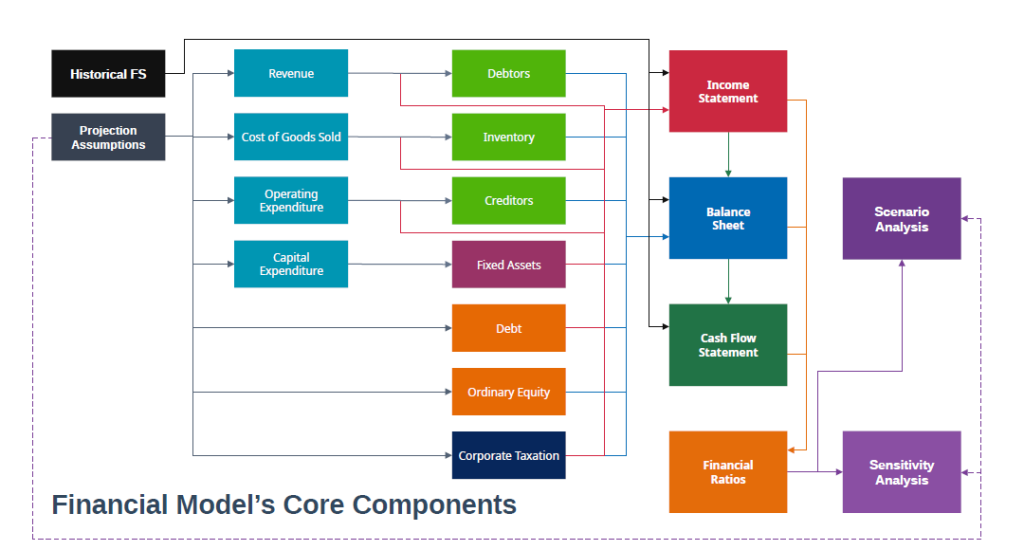
Financial Model’s Core Components
Jadwal Training Public Company Financial Modeling 2027
Training berlangsung dua hari penuh setiap batch, full-day training pukul 09.00–17.00. Berikut jadwal batch sepanjang 2027:
- 21–22 Januari 2027
- 15–16 Februari 2027
- 24–25 Maret 2027
- 15–16 April 2027
- 24–25 Mei 2027
- 17–18 Juni 2027
- 15–16 Juli 2027
- 19–20 Agustus 2027
- 16–17 September 2027
- 18–19 Oktober 2027
- 15–16 November 2027
- 16–17 Desember 2027
Venue Training
Training Public Company Financial Modeling diselenggarakan di tiga kota:
- Jakarta Selatan: Swiss-Belinn Simatupang (Jakarta Selatan), Swiss-Belhotel Pondok Indah (Jakarta Selatan), Ibis Styles Simatupang (Cilandak, Jakarta Selatan), dan Hotel TMG Tebet (Tebet, Jakarta Selatan).
- Yogyakarta
- Bandung, Jawa Barat
Investment Fee
Offline Training: Rp5.950.000 per peserta.
Biaya sudah termasuk training material, sertifikat, lunch dan coffee break, souvenir, serta door prize.
Opsi In-House Training
Program ini juga dapat diselenggarakan sebagai in-house training dengan kapasitas maksimal 20 peserta per batch. Untuk membahas kebutuhan tim Anda, hubungi kami lewat halaman kontak Seventh atau pelajari layanan in-house training Seventh Grace Consulting.
Profil Trainer: Purwadi Nitimidjojo
Purwadi Nitimidjojo adalah spesialis financial modeling dan credit analysis dengan pengalaman lebih dari 30 tahun di corporate banking, leasing, multi-finance, restrukturisasi utang, dan konsultasi. Ia memiliki lebih dari 25 tahun pengalaman membangun model keuangan di Microsoft Excel untuk corporate finance, corporate banking, debt restructuring, dan project finance.
Kariernya dimulai di perbankan, termasuk The Chase Manhattan Bank, PT Bank PDFCI, Badan Penyehatan Perbankan Nasional (IBRA), dan PTANJ Finance. Pada 2006–2012 ia menjadi Consultant & Trainer di Omega Performance, vendor credit analysis yang kini dimiliki Moody’s Corporation. Pada 2012–2020 ia menjabat Director, Financial Modeling di Deloitte Indonesia, lalu melanjutkan sebagai Senior Specialist hingga Mei 2022. Sejak Juni 2022 ia menjadi Senior Advisor & Trainer, Financial Modeling di BDO in Indonesia.
Ia telah melatih profesional keuangan dari lebih dari 1.000 perusahaan di Indonesia, Singapura, Malaysia, Thailand, dan Kamboja. Sejak 2026 ia mengembangkan kerangka kerja AI-assisted modeling, termasuk 3-Tier Prompt Framework, MIRROR Method, dan MIDAS (Multi-Indexed Datatable Analysis System) untuk analisis skenario. Ia lulusan Fisika Institut Teknologi Bandung (ITB), dan pelatihan dapat disampaikan dalam Bahasa Indonesia maupun Inggris.
Mengapa Mengikuti Training Ini
Model keuangan perusahaan terbuka punya data yang rapi, tetapi ukurannya besar. Karena itu, spreading manual memakan waktu dan rawan salah. Dengan workflow sepuluh langkah, Anda mengerjakan spreading, analisis rasio, dan proyeksi secara bertahap, lalu memeriksa setiap hasil di Excel.
Selain itu, Anda pulang membawa workbook 12 sheet, sepuluh prompt yang bisa dipakai ulang, dan satu master prompt. Hasilnya, Anda dapat mengulang proses public company financial modeling pada emiten lain di sektor yang berbeda. Platform AI yang Anda pilih, Claude atau ChatGPT, tidak mengubah alur kerjanya.
Ingin memperdalam sisi lain? Lihat juga Financial Modeling & Analysis with Claude AI, Financial Analysis, Modeling & Forecasting with Claude AI, Modeling Under Uncertainty with Claude, dan Business Plan Modeling with Claude Cowork and Claude Code. Semua program tersedia di katalog training Seventh.
FAQ Public Company Financial Modeling with Claude or ChatGPT
Apa yang dipelajari dalam training Public Company Financial Modeling with Claude or ChatGPT?
Peserta melakukan spreading laporan keuangan audited lima tahun, membangun model tiga laporan yang terhubung, memproyeksikan lima tahun ke depan, menjalankan model checks, lalu menguji hasilnya dengan Tornado dan MIDAS scenario analysis.
Apakah saya harus memilih Claude atau ChatGPT?
Pilih salah satu. Workflow sepuluh langkah dan arsitektur 12 sheet yang sama berlaku untuk keduanya, dan Anda memakai satu platform sepanjang training.
Apa yang harus saya bawa?
Bawa laptop, Excel versi desktop, dan akses ke Claude atau ChatGPT dengan fitur file upload dan workbook creation aktif. Uji unggah file dan unduh workbook sebelum kelas dimulai.
Kapan jadwal training tahun 2027?
Tersedia dua belas batch, dari 21–22 Januari 2027 sampai 16–17 Desember 2027. Setiap batch berlangsung dua hari, pukul 09.00–17.00.
Di mana lokasi training?
Di Jakarta Selatan (Swiss-Belinn Simatupang, Swiss-Belhotel Pondok Indah, Ibis Styles Simatupang, atau Hotel TMG Tebet), Yogyakarta, dan Bandung, Jawa Barat.
Berapa biaya training?
Offline training Rp5.950.000 per peserta, sudah termasuk training material, sertifikat, lunch dan coffee break, souvenir, serta door prize.
Apakah tersedia in-house training?
Ya, dengan kapasitas maksimal 20 peserta per batch.
Daftar Sekarang
Amankan kursi Anda di batch 2027 dan kuasai public company financial modeling bersama Claude atau ChatGPT. Pendaftaran dapat dilakukan lewat WhatsApp 08156558677, halaman kontak Seventh, atau katalog training Seventh.id. Kenali penyelenggaranya di halaman layanan Seventh Grace Consulting.